
Blog
Rapping my asana

What do think about music and yoga asana?
Inspired by a yoga class with the Future Sound of Yoga at the Spirit Festival (and memories of Jivamukti classes in Sydney years ago), I practiced with music today.
And not my usual gentle, lyrical Donna De Lory, Jo Kelly, Deva Premal, Amrit Kirtan playlist. Today I turned it up LOUD, burnt some incense, and grooved my way through an Ashtanga sequence.
Today I played MC Yogi.
It seems that music in yoga in controversial. I’ve heard people aghast at the idea. That it’s a spiritual practice designed to take you inwards, and music takes you outwards. But I’m not buying the idea.
When I practiced asana in India, it was always in silence.
I know traditionally asanas (yoga postures) are practiced in silence, but I’m not a traditionalist. I believe in following my own path, my own dharma.
And today, my path was a musical one. A loud, rapping, MC Yogi one.
I loved it.
I flowed right through the practice. It was beautiful. It was joyful. It was light. It was fun. And instead of leading me out, it took me in.
At the Byron Spirit Festival a couple of weeks ago, Dave Stringer talked about the history of kirtan. He said that kirtan came about when the Bhakti yogis tried to break down the caste system in India, by chanting devotional music in the street…. chants that were traditionally only accessible to the Brahman caste (if you were of a lower caste, you had to wait for another life time to be born into a higher caste).
Dave said that at first the upper castes rejected the idea of chanting sacred mantras in the street. They were very (to say the least) unhappy about the whole affair. And eventually, over time, they got used to it.
Until the Bhakti yogi’s started using an instrument that was previously only used in the brothels. People were up in arms about Bhakti yogis chanting sacred mantras in the street, while playing instruments associated with prostitutes. But it sounded so good, and they eventually got used it.
Then they started playing tablas with animal hides. A Muslim instrument (with animal skin!) accompanying Hindu devotional chants! Again, an outrage. Until everyone got used it.
And then the British came along with their harmonium, and the Bhakti’s started including these too. The instrument of the oppressor! An outrage. And again, you guessed it, everyone got used to, and it became an accepted part of kirtan, like all the instruments before it.
And then in the 70’s the Westerners ventured to India with their acoustic guitars….. ahhh folk music! And then we all got used to it.
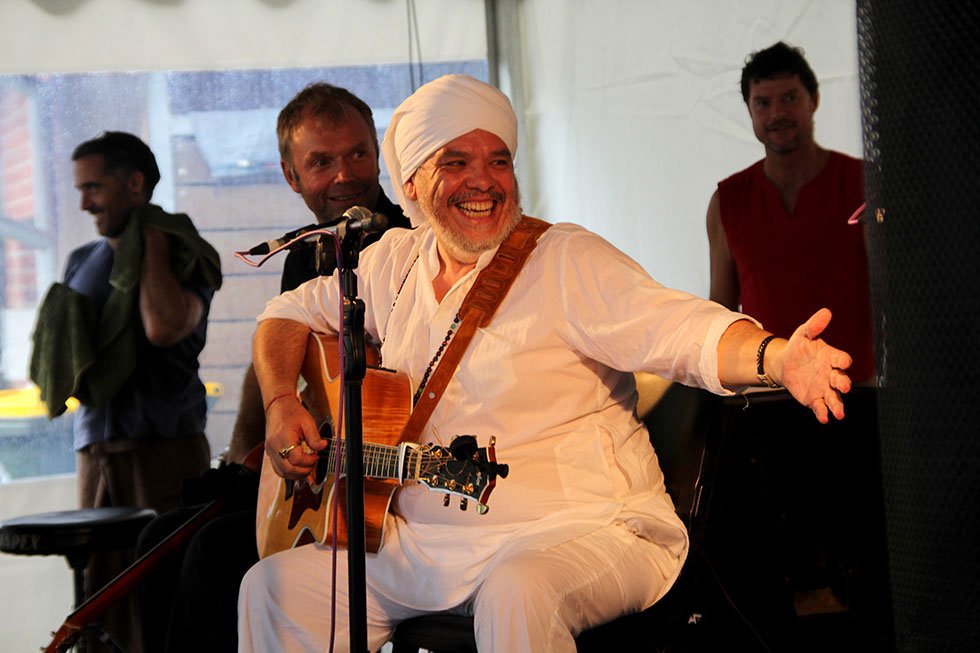
Now days people are freaking out about including electric guitar in kirtan. Like it’s some kind of sacrilegious thing to do.
But really, kirtan (and yoga) are an evolving practice, it’s a living tradition that evolves with the zeitgeist. Not, as Dave puts it a “dusty ethno-musical logical or spiritual museum piece.”
The Bhakti’s weren’t concerned about whether the instruments were Hindu, Muslim or Christian, or whether it was from a brothel, a different caste or Western folk culture. It didn’t matter one bit. It was about love.
As Dave puts it, “the idea was that if there was love to be found or a divine to be connected with, that the place to connect was within your own heart and your own practice and your own experience. You didn’t need a priesthood or any special knowledge in order to make this connection. That singing and dancing and connecting with other like-minded people was the quick way to get there” (quote from this great interview with Dave Stringer).

My practice.
My journey.
My musically inclined way of grooving through my practice and connecting with the divine.
I’m not saying that MC Yogi will be accompanying me on my stereo everyday, but that when he does, I know that I’m practicing MY yoga, the way that works for ME.
And in my mind, that’s what it’s all about.

How do you practice? Do you turn up the music?
I’d love to hear your thoughts in the comments below.
Namaste,

2 Comments
Submit a Comment
WANT MORE LIKE THIS IN YOUR INBOX?

Mental Health and COVID-19
With much of the world going into lock down as a result of COVID-19, one of the biggest global health risks we’re facing right now is mental illness. Loneliness, as a result of social distancing, and stress as a result of the financial implications of lock down and health fears, are very...

Ahiṁsā (non-violence)
Let's dive into the Yoga Sūtras together. Patañjali’s Yoga Sūtras are an ancient yogic text, and a practical guide to self-understanding and enlightenment (as we saw in this article). They outline eight limbs for achieving the goal of yoga, including the yamas, niyamas, āsana, prāṇāyāma,...

Eight Limbs of Yoga
It is thought that Patañjali was an ancient sage who wrote down the vedic knowledge of the time into sūtras, so they could be handed down orally from teacher to student. These sūtras comprise of a series of experiments or practices that are designed to realise the teachings of Sāṅkhya, teachings...
You’ve got it. Like with everything else in life, being stagnated and bound to rigid rules that we, for some reason, perceive as the ultimate truth, holds us back from exploring and experiencing some things, so instead lets be creative and accepting of the old and new and the differences on our path to enlightenment. 🙂 Personally with music, it depends which mood I am in, to which music I am listening, sometimes its got to be loud, sometimes really shanti. 🙂
Om shantis to you Annie x