Meet the teacher: Richard Miller

Meet the teacher: Richard Miller

Blog

Meet the teacher: Richard Miller

Today I’m so honoured to introduce you to my teacher Richard Miller.  Like me, Richard is a Clinical Psychologist and Yoga Teacher, and he is a guest teacher on A Daily Dose of Bliss.

Richard is the creator of Integrative Restoration Yoga Nidra (iRest), and he has been practicing, teaching and researching this life changing practice for the past 40 years.  He knows his stuff!

I feel in love with iRest a few years ago, and have been practicing it myself on a daily basis ever since.  I teach classes regularly here in Byron Bay and around the world, and I integrate the teachings of iRest into my counselling practice.  It’s really had a profound impact on my life, both personally and professionally.

So I’m sure you can imagine I was just a little bit excited when Richard agreed to be a guest teacher on A Daily Dose of Bliss and to be interviewed for my blog.

I hope you enjoy this as much as I do,


Lauren: How did you come to practice and teach yoga nidra Richard?

Richard: During my first yoga class that I attended in 1970, the teacher gave a rudimentary yoga nidra practice at the end of the class. I had a powerful transformative experience during the yoga nidra, which led me to undertake studies to understand this ancient practice, and to begin teaching the practice in the yoga classes I was invited to teach by my yoga mentor, starting in 1974.

Lauren: What is iRest Yoga Nidra and why should be practice it?

Richard: iRest is a modern-day secular adaptation of the 4500 year old ancient practice of yoga nidra meditation, that is based on the teachings of Samkhya, Patanjali, Advaita, and Unqualified Kashmir Nondualism. In 2004 I was asked by the US military, during a research study examining the efficacy of yoga nidra with wounded warriors returning from their military service suffering PTSD, to change the name, as, in the words of the military in 2004, “We’re soldiers. We don’t do yoga!”

I proposed the name Integrative Restoration – iRest. Integrative, as yoga nidra integrates the psyche so that we are fully functioning, psychologically healthy human beings; Restoration, as yoga nidra restores our experience of interconnectedness with both ourselves and with the entire universe; and iRest, as the process helps the ego-I come to its proper functioning, not as the head of household, but as a servant or functioning, out of many functionings, that is in service to the life force that is living us as human beings.

The military loved the name “iRest”. Upon completion of the research, the military said I was welcome to call the practice Yoga Nidra. So I now call what I do: Integrative Restoration – iRest Yoga Nidra Meditation.

One should practice iRest for many reasons. It helps us become whole, healthy human beings…integrated at all levels of our body, mind, and psyche. It helps us become partners with our body, sensations, emotions, thoughts, joy and well-being. And the practice supports our connection/relationship with ourselves, others and the world and universe around ourselves.

It’s a comprehensive and complete program of meditation, with the ultimate aim of awakening or enlightenment, and the integration of enlightened understanding into all aspects of daily life: self, relationships, family, work, and play.

Lauren: What does your personal yoga practice look like?

Richard: I have a formal iRest meditation practice each morning, and then I’ve integrated the principles of iRest Yoga Nidra Meditation into all aspects of my daily life. iRest is the way I live my life with everyone, in every moment of every day and circumstance. The principles support me in welcoming life, as it is, on life’s terms.

Lauren: If you could share just one pearl of yogic wisdom with the world, what would it be?

Richard: We need to learn how to welcome each moment, each emotion, each thought, each person we are with, including ourselves, just as we are. We contain within us the perfect response to each moment, and can understand this perfect response when we’re willing to welcome and be with the “what is” of each moment. We are not-separate from the universe. We are each a unique and perfect expression of life. We each have value, meaning and purpose. We just need to learn how to stop, listen and respond. This is what iRest Meditation teaches us.

Lauren: In this moment, what are you grateful for?

Richard: Having learned how to welcome myself and others…I feel Love for everything…gratitude for everything…Bottom line…

Lauren: What are you inspired by?

Richard: The resiliency that’s built into us as human beings. We are capable of great things. We are able to thrive, not just survive the vicissitudes of life. Practices like iRest Meditation provide us the tools, that have been time-tested and handed down to us by the ancients, which enable us to meet life on its terms, and experience love, well-being, compassion and kindness, no matter the circumstance.

Lauren: What are you trusting in?

Richard: I trust life. I trust my body’s ability to know what to do in each moment, and it’s ability to convey this understanding to my mind. I trust that when I respond, love arises in each moment, as I remain connected to myself, others, and the world around me. I trust that when I begin to separate, by bodymind is hardwired to tell me that this is happening, and to provide me the cues to get back on track. I trust life.


Richard C. Miller, PhD is a clinical psychologist, author, researcher, yogic scholar and spiritual teacher. His work integrates the wisdom teachings of Eastern and Western psychology and philosophy.

Richard is the president of the Integrative Restoration Institute and author of Yoga Nidra: The Meditative Heart of Yoga, and The iRest Program for Healing PTSD.

Richard teaches internationally leading trainings and retreats on enlightened living in daily life, and is a guest teacher on A Daily Dose of Bliss.


The information provided on this podcast is intended for informational purposes only and should not be considered professional advice

WANT MORE LIKE THIS IN YOUR INBOX?

[et_bloom_inline optin_id="optin_9"]
How To Change a Habit…. For Life!

How To Change a Habit…. For Life!

Let's start with a paradox.  You are perfect, just as you are.  You don't need fixing or changing. There's nothing more you need to do, or know, or have, to make you any better than you already are.  You are perfection itself. And at the same time, perhaps there's something in your life that you...

read more
Eat slow, breathe deep, live well

Eat slow, breathe deep, live well

I've always been a big advocate of breathing well.  Breathing gently, rhythmically and all the way down into the belly is one of the best things you can do for your health and your happiness.  It's a very simple and embodied practice we can all do to tap into our nervous system and bring the body...

read more
10 Easy Ways to Cultivate Gratitude

10 Easy Ways to Cultivate Gratitude

OK, so you've probably guessed by now that I'm a bit of a fan of gratitude.  A gratitude practice seriously takes very little time and it's impact is HUGE!  As a busy mama of two, both of these components are very important to me. Gratitude researchers Emmons and McCullough (2003) found that a...

read more

Join our community over at the Yoga Psychology Institute and download my favourite Spotify playlist for nervous system regulation

On intuition, happiness & internal GPS systems

On intuition, happiness & internal GPS systems

Blog

On intuition, happiness & internal GPS systems

Did you know you have a mechanism inside you that gives you all the answers you need to be happy? Really, truly happy? And not just your own happiness, but the happiness and harmony of the whole world?

The only really valuable thing is intuition” Albert Einstein

It’s called by many names, you might have heard a few of them. Intuition. Inner guru. The goddess. Deep knowing. Inner being.  Satguru. Gut instinct.  That feeling in my belly.  It’s like an inbuilt GPS system that helps us to navigate the world.  It shows up as a resonance in our body, a lightness in the air, a deep knowing, a synchronicity in the world, a sense of clarity and it speaks to us in our dreams. Your intuition is there, whether you’re listening to it or not. Are you? Your intuition is your most powerful ally in this world.  It will help you to live a life that is in accordance with your most deepest heartfelt desires. Get to know your intuition.  Make friends with her (or him).  Allow her into your inner sanctum and to be your most intimate advisor.   After all, she probably knows your needs better than your thinking mind does. In her powerful book ‘Women Who Run with the Wolves’, Clarissa Pinkola Estés says that when we’re not grounded in our instinctual self, we often believe that there is only one path open to us. But when we’re listening to our intuition we have at least four choices; the two opposites, the middle ground and the “taken under further contemplation.” I’m a big fan of Brene Brown’s work, and I’m sure she would agree this last point. In her book ‘The Gifts of Imperfection’ she points out that while our intuition often tells us what we need to know and whispers ‘follow your instincts’, it sometimes shouts ‘you need to check this out; we don’t have enough information!’ And because we humans are often not very good with uncertainty, we start asking other people for their advice, and end up taking a path that isn’t our own. Brene uses her tendency for overly surveying other people as a red flag that she’s not in tune with her own intuition. Intuition is not governed by ego or social expectations.  It does not choose to play nice or to play safe. Intuition is guided by our deepest heartfelt desires, and if we’ve been suppressing these, or the people around us are not supportive of them (or worse consider them shameful) it can be all too easy to shut off from our intuition. We turn away, and we stop listening.

“Intuition is really a sudden immersion of the soul of the universal current of life, where the histories of all people are connected, and we are able to know everything, because it’s all written there.” Paulo Coelho in The Alchemist

“You have to leave the city of your comfort and go into the wilderness of your intuition. What you’ll discover will be wonderful.” Alan Alda
But while our intuition can be neglected, it is never silenced.  She is insistent.  She wants to be heard.  She starts speaking to us in whispers, and when we don’t listen she tries all kinds of tactics to get our attention. That niggling feeling that something is not quite right. The waking up at 3am feeling anxious. The tightness in the throat. The nausea in the belly. The anger at the injustice of life. The depression.
The first step in getting to know your intuition is to believe and to trust.  Belief simply in the existence of your intuition, and trust that you have all the answers you need inside of you (or at the very least suspend judgement for a little while, and be open to the possibility). Get to know your body.  This is often how intuition speaks.   If you’re making a decision, imagine yourself having taken one path, and notice how that feels in your body.  Then imagine the other path, and sense how that feels.  This is going to be different for everyone, but for me, the choice that is most in line with my heartfelt desires feels light and spacious.  The choice that is not feels heavy and contracted. When I listen to these resonances in my body, I’m in direct communication with my intuition. But sometimes I can’t tell the difference.  One decision feels no different than the other.  Then I interpret this in one of two ways;  (1) that either choice would be fine, or (2) that I need more time to figure this one out. And how to I differentiate between the two?  I use my intuition.  I feel into it. We can hone our intuition simply by practicing.  Each time you make a decision, pause for a moment and tune into your inner knowing.  Start with small decisions, like shall I have rice or pasta for dinner?  Feel what feels like the right decision to make. Shall I take the highway or the scenic route home? Shall I work a little longer tonight or go to a yoga class? Shall I play some music or would silence feel better now?
Then try asking the bigger questions. Shall I stay in this relationship and try to make it work or call it quits? Shall I start my own business or stay on as an employee? Is this really my soul purpose? An important way to make room for our intuition is to drop out of the thinking mind.  A regular meditation practice (even if it’s just 5 minutes a day) can be a beautiful way to cultivate this, and help us to access a place of stillness and calm.  This is where our wisdom resides.
And with a quiet mind, we can hear the whispers of our intuition. She no longer needs to roar. Give it a go!  Start small, and see where it takes you. Leave me a comment below.  Do you listen to your intuition?  Do you follow it’s guidance?  I’d love to hear all about it.

The information provided on this podcast is intended for informational purposes only and should not be considered professional advice

WANT MORE LIKE THIS IN YOUR INBOX?

[et_bloom_inline optin_id="optin_9"]
How To Change a Habit…. For Life!

How To Change a Habit…. For Life!

Let's start with a paradox.  You are perfect, just as you are.  You don't need fixing or changing. There's nothing more you need to do, or know, or have, to make you any better than you already are.  You are perfection itself. And at the same time, perhaps there's something in your life that you...

read more
Eat slow, breathe deep, live well

Eat slow, breathe deep, live well

I've always been a big advocate of breathing well.  Breathing gently, rhythmically and all the way down into the belly is one of the best things you can do for your health and your happiness.  It's a very simple and embodied practice we can all do to tap into our nervous system and bring the body...

read more
10 Easy Ways to Cultivate Gratitude

10 Easy Ways to Cultivate Gratitude

OK, so you've probably guessed by now that I'm a bit of a fan of gratitude.  A gratitude practice seriously takes very little time and it's impact is HUGE!  As a busy mama of two, both of these components are very important to me. Gratitude researchers Emmons and McCullough (2003) found that a...

read more

Join our community over at the Yoga Psychology Institute and download my favourite Spotify playlist for nervous system regulation

How to make new year’s resolutions that really work

How to make new year’s resolutions that really work

Blog

How to make new year’s resolutions that really work

Each year, people all over the world set intentions for themselves for the new year.

Stop smoking, loose weight, don’t be such a push over, make more money, be nicer, find a better job, stop biting my nails, be more confident, you know the list right?

And year in and year out, people fail at living up to these resolutions, then fall into the downward spiral of self judgement, self criticism, hopelessness and helplessness.

New year’s resolutions fail for many reasons.

  1. They’re not REALLY what we want.  We choose things we think we should want, or what our ego wants, rather than our deepest heartfelt desires
  2. We start doing what psychologists call a ‘discrepancy analysis’ (comparing where we are now, to where we want to be) and feel overwhelmed and dis-empowered, and just give up
  3. We are unconscious of our old habits keeping us in old ways of being, and as soon as the shine wears off the declaration of the new years resolution, we slide back into our old ways of being in the world, without understanding what has happened
  4. We’re not wording the intention with enough clarity

This year, I propose a new way to think about new years resolutions.

This year, let’s forget about goals and instead consider the following…..

How do you want to feel?

How do you want to be in the world?

What are your deepest heartfelt desires?

Goals are things that you achieve, that you tick off your list, and then you’re done.  Get married, have a great job, drive an awesome car, master the 2nd series Ashtanga Vinyasa sequence, sit in meditation for an hour without moving.

Heartfelt desires are ways of being in the world on a day-by-day, even moment-by-moment basis.

I am free

I love and I value myself

I am open & courageous

I engage in the world with love, truth and ease

And when you’re living your life in accordance with your deepest heartfelt desires, then everything else just falls into place.

In each iRest Yoga Nidra course or workshop I teach, we spend time diving deeply into heartfelt desires.  Asking the question “what do I REALLY want from this life?” and exploring ways to language it and integrate into our lives in a way that is most effective.

On the 2nd of January 2015, I’m teaching an iRest one day retreat in beautiful Byron Bay, and the focus of the retreat is going to be creating clear and meaningful intentions for the new year.

Then we’ll be weaving our heartfelt desires and intentions into the yoga nidra meditation so they really starts working their magic on your life.

I do hope you can join me.

The retreat is hosted by Byron Yoga and the Purna Retreat Centre, and they’ll be putting on a delicious vegetarian lunch.

The early bird price is still available for a few more days.

To find out more and to register online head on over here.

I look forward to sharing this beautiful practice with you!

With gratitude,

The information provided on this podcast is intended for informational purposes only and should not be considered professional advice

WANT MORE LIKE THIS IN YOUR INBOX?

[et_bloom_inline optin_id="optin_9"]

How To Change a Habit…. For Life!

How To Change a Habit…. For Life!

Let's start with a paradox.  You are perfect, just as you are.  You don't need fixing or changing. There's nothing more you need to do, or know, or have, to make you any better than you already are.  You are perfection itself. And at the same time, perhaps there's something in your life that you...

read more
Eat slow, breathe deep, live well

Eat slow, breathe deep, live well

I've always been a big advocate of breathing well.  Breathing gently, rhythmically and all the way down into the belly is one of the best things you can do for your health and your happiness.  It's a very simple and embodied practice we can all do to tap into our nervous system and bring the body...
read more
10 Easy Ways to Cultivate Gratitude

10 Easy Ways to Cultivate Gratitude

OK, so you've probably guessed by now that I'm a bit of a fan of gratitude.  A gratitude practice seriously takes very little time and it's impact is HUGE!  As a busy mama of two, both of these components are very important to me. Gratitude researchers Emmons and McCullough (2003) found that a...

read more

Join our community over at the Yoga Psychology Institute and download my favourite Spotify playlist for nervous system regulation

Keeping calm in the silly season

Keeping calm in the silly season

Blog

Keeping calm in the silly season

Christmas can be a crazy time of year. Yes, there’s presents, and cake, and gatherings with loved ones, but there’s also family dramas, overindulging, spending way too much money, reminders of people who have gone, and all sorts of other emotional turbulence that emerges around the holiday period. Would like to stay calm, centered and blissful this year? This year I’m teaching a 6 week course over the Christmas/New Year period, to help you do just that. We’ll kick off on December 8th to set the ground work, and by Christmas Day you’ll have learnt practices to breathe well, to balance and to calm your mind. Between Christmas and New Year there will be practices to deeply relax. On New Year’s Eve, we’ll kick off with energising practices. And in early 2015, you’ll be doing practices for grounding, kindness & compassion, and to cultivate your inner sense of BLISS. What a beautiful way to start the new year!
I know it’s a busy time of year. That’s why I’ve kept these lessons short and sweet. It only takes 5 – 10 mins each day to access your bliss. I’ll talk you through each practice in my online shala, and over the 6 weeks your bliss-toolbox will be full of surprisingly simple and powerful practices you can pull out whenever you need to, to find balance, ease and happiness amidst the craziness. I hope you can join me and my team of internationally acclaimed yoga teachers for A Daily Dose of Bliss. I’ll be teaching most of the practices with my teaching assistant Rosie (in the photograph above), and the guest teachers will be popping in to the online shala now and again to share with you some beautiful music and meditations.
Join me and the Daily Dose of Bliss community and bring back the joy and happiness into Christmas this year. More information and registration is here. The early bird price finishes tonight! Namaste,

The information provided on this podcast is intended for informational purposes only and should not be considered professional advice

WANT MORE LIKE THIS IN YOUR INBOX?

[et_bloom_inline optin_id="optin_9"]
How To Change a Habit…. For Life!

How To Change a Habit…. For Life!

Let's start with a paradox.  You are perfect, just as you are.  You don't need fixing or changing. There's nothing more you need to do, or know, or have, to make you any better than you already are.  You are perfection itself. And at the same time, perhaps there's something in your life that you...

read more
Eat slow, breathe deep, live well

Eat slow, breathe deep, live well

I've always been a big advocate of breathing well.  Breathing gently, rhythmically and all the way down into the belly is one of the best things you can do for your health and your happiness.  It's a very simple and embodied practice we can all do to tap into our nervous system and bring the body...

read more
10 Easy Ways to Cultivate Gratitude

10 Easy Ways to Cultivate Gratitude

OK, so you've probably guessed by now that I'm a bit of a fan of gratitude.  A gratitude practice seriously takes very little time and it's impact is HUGE!  As a busy mama of two, both of these components are very important to me. Gratitude researchers Emmons and McCullough (2003) found that a...

read more

Join our community over at the Yoga Psychology Institute and download my favourite Spotify playlist for nervous system regulation

Yoga for bliss & happiness

Yoga for bliss & happiness

Blog

Yoga for bliss & happiness

One thing I love about yoga is that it’s just so damn practical.

When I’m feeling stressed, I practice Yogic Breathing.

When I’m feeling anxious and overwhelmed, I practice Mountain Climbing Breath.

When I’m low on energy and I need to get going, I practice Right Nostril Breathing.

When I’m feeling a bit all over the place, I practice Alternate Nostril Breathing.

And when I’m feeling exhausted (and this one is my favourite), I practice iRest Yoga Nidra.

I start my day most mornings with some sun salutations, then throughout the day I take just a minute or two to do one of the many yogic practices to help me to recover my sense of calm, balance and bliss.

It really helps me to tap into my true nature, which is happiness (cool huh?).

Yoga has this reputation of just being a set of postures we do in the yoga studio with fancy leggings, but it is so much more.  Yoga is an very practical science that helps us to remain sane in an increasing insanely busy world.

Sounds to easy to be true?  It really isn’t.

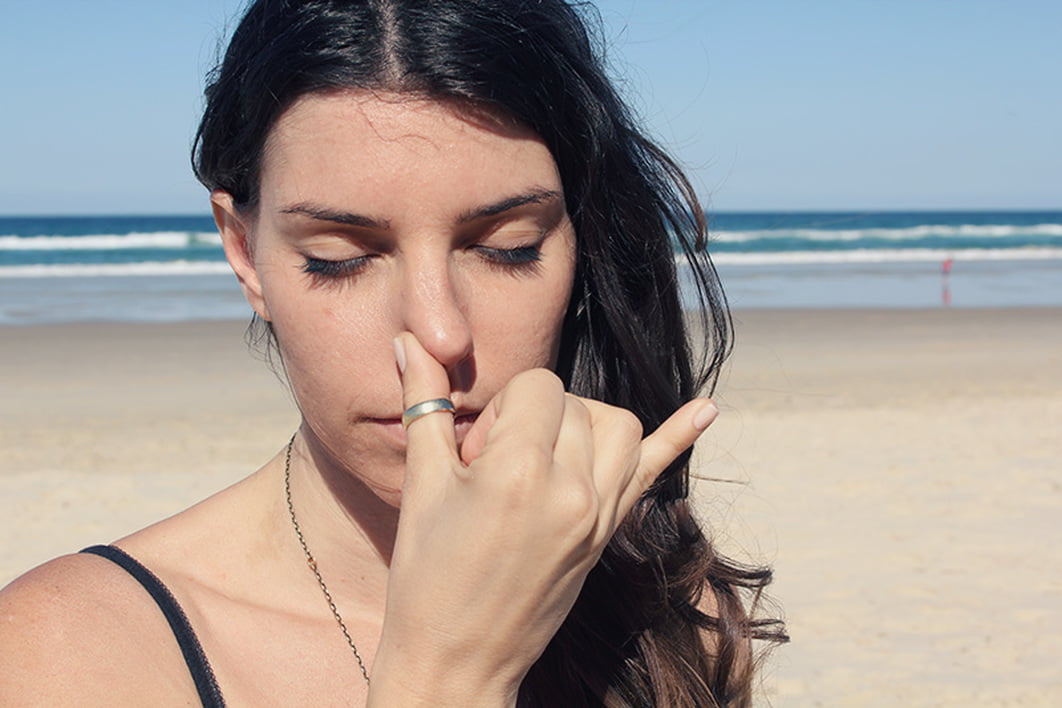
Let me share one example with you, the preparatory practice for Alternate Nostril Breathing, with the help of my teaching assistant ….

Alternate nostril breathing (or Nadi Shodhana) is said to balance the left and right sides of the brain, to balance our masculine and feminine qualities, to calm and focus the mind, to increase vitality, lower stress and anxiety and lead us to deep states of meditation and spiritual awakening (not bad, eh?).  It’s a beautiful practice to do if you’re feeling generally a bit unbalanced or out of whack, and before you sit for an extended formal meditation practice.

If you’d like to try a preparatory practice of Alternate Nostril Breathing, sit in a comfortable position and close your eyes (you might like to read through the instructions first though!).

Take a few moments to notice the natural rise and fall of your breath.

Lift your right hand and place one finger or thumb on each nostril.

Traditionally it’s done like this (with the middle and forefingers resting between the eyebrows or tucked down)……

….. but you find the way that feels best for you.

Gently press the right nostril, and breath naturally and rhythmically (without force) through the left nostril for just a few breaths (no more than 5).

Then release the right nostril, and gently press the left nostril, breathing naturally and rhythmically, without force, through the right nostril for another few breaths (again, no more than 5).

If you feel dizzy or uncomfortable at any time, stop the practice and sit for a few moments observing your breath.

If it feels good, repeat a couple of times on each side.

Lower your hand (release the mudra) and sit for moment, noticing the effects of the practice on your body, breath and mind.


I’ve been travelling the world studying and teaching yogic practices for over a decade, and not only do I practice them myself on a daily basis, but I also teach them to my clients and yoga students.

My gorgeous husband has kindly built me a virtual yoga shala, so I can now teach these practices online too.

I’m so excited to be able share these teachings with you, where ever you are in the world.

I’m joined by a host of internationally acclaimed yoga teachers, including Sharon Gannon, Krishna Das, Rachel Zinman, Amy Weintraub, Rick Hanson, Marianne Elliott and many many more.  They’ve the best at what they do, and I’m excited they’re joining me in the shala.

I so hope you can join me in this online yoga course, called A Daily Dose of Bliss.  You’ll learn 37 new yoga practices in 6 weeks, to bring a deep sense of ease, calm and bliss into your day.

I’ll be guiding you through the practices with video and audio (as well as beautiful photography like you see above).

And it will only take 5 – 10 minutes each day.

Ready to find your bliss?

Come join us here.

Namaste,

The information provided on this podcast is intended for informational purposes only and should not be considered professional advice

WANT MORE LIKE THIS IN YOUR INBOX?

[et_bloom_inline optin_id="optin_9"]
How To Change a Habit…. For Life!

How To Change a Habit…. For Life!

Let's start with a paradox.  You are perfect, just as you are.  You don't need fixing or changing. There's nothing more you need to do, or know, or have, to make you any better than you already are.  You are perfection itself. And at the same time, perhaps there's something in your life that you...

read more
Eat slow, breathe deep, live well

Eat slow, breathe deep, live well

I've always been a big advocate of breathing well.  Breathing gently, rhythmically and all the way down into the belly is one of the best things you can do for your health and your happiness.  It's a very simple and embodied practice we can all do to tap into our nervous system and bring the body...

read more
10 Easy Ways to Cultivate Gratitude

10 Easy Ways to Cultivate Gratitude

OK, so you've probably guessed by now that I'm a bit of a fan of gratitude.  A gratitude practice seriously takes very little time and it's impact is HUGE!  As a busy mama of two, both of these components are very important to me. Gratitude researchers Emmons and McCullough (2003) found that a...

read more

Join our community over at the Yoga Psychology Institute and download my favourite Spotify playlist for nervous system regulation

The gratitude jar…..

The gratitude jar…..

Blog

The gratitude jar…..

When I started sharing my gratitude photographs, even before Capturing Gratitude was born, I began getting emails from people all over the world, sharing their own gratitude stories. I recently heard from Leonie Percy, the founder of Yoga Mamata, and loved her story about the gratitude jar so much, that I invited her to share it with you here on my blog. So I’ll hand over to Leonie now (and be sure to check out Leonie’s give away at the end) ……

Gratitude. Gratitude is magic because it turns what we have into enough. The first time in my life I felt truly grateful was when I spent a few months travelling around the middle east. I was only 19 and it was my first experience of travelling solo. It was the beginning of a journey of self discovery that would take me to over 65 countries, all before I was 30. I love travelling, it brings a sense of freedom, joy and infinite peace that seems to be a struggle for many of us to find when we live in the mundane routine of the daily grind. I was so grateful I got to experience so many cultures and meet so many interesting people. I also felt overwhelming grateful to my family as I felt a sense of appreciation for my parents that I had not felt before. I got married when I was 30 and had my son at 32 but by the time I was 35 my marriage ended suddenly and I found myself trapped in a heart breaking situation that left me a single mother. I struggled to deal with what was happening, as my world fell apart, I had to start a new life. During this time all I knew was that I loved yoga and my son. I dived into my yoga practice and embraced the teachings of this ancient art and it was here that I once again discovered the magic of gratitude. Instead of focusing on all the negative energy around me I began to practice gratitude. I am grateful for my son. I am grateful for my breath. I am grateful I am healthy. I started to meditate and practice mindfulness and this led to create my business www.yogamamata.com that teaches yoga and mindfulness to families. I am the author of an award winning book “Mother Om – Connect with yourself and your child in one mindful moment a day”. In “Mother Om” I share practical mindful tips on how to strengthen family connection. An absolute gem is to create a family gratitude jar. Find a glass jar and place it in the kitchen. Everyday as a family ritual write down what you are grateful for. A great time for this is around the dinner table. Get the kids to do this too. When teaching kids about gratitude ask them what makes them feel happy in their heart. I am grateful for my family. I am grateful for mummies hugs. I am grateful for my pet. Write them on posit notes and put them in the jar. Stick the notes in lunch boxes and hide them around the house. When feeling stressed just put out a posit note and read it. This instantly takes you out of your busy mind and into your heart space, where there is only love, no judgment or fear. Gratitude is a daily mindfulness practice that helps you feel connected to yourself and the world around you. You don’t long for your situation to be different and become content with your life. It brings you happiness which is a state of mind. Before I fall asleep or before I get out of bed in the morning I say to myself what I am grateful for. In this moment I find that sense of freedom, joy and infinite peace that I found when I was travelling. All you have to do is close your eyes and focus on what you have, rather than what you want or think you need, so sprinkle some of that magic into your day to keep yourself and your family connected content and calm.


I’m so grateful to Leonie for sharing this gratitude idea with us. Would you like a signed copy of Leonie’s new book, Mother Om? Click the facebook like button AND leave a comment below about how you bring gratitude into your day, and one lucky person will win a signed copy of this wonderful book! The winner will be announced on Friday 7th November 2014. I’m excited!  Get liking and commenting!
UPDATE: Congratulations to Lainie for winning a copy of Mother Om!

Leonie is a loving mother, founder of www.yogamamata.com and author of the award winning book “Mother Om – Connect with yourself and your child in one mindful moment a day”. Yoga Mamata teaches Mums how to mother in the moment, children kindness and resilience and keeps families connected. Mother Om can be purchased here in Australia or globally on Amazon.
 

The information provided on this podcast is intended for informational purposes only and should not be considered professional advice

WANT MORE LIKE THIS IN YOUR INBOX?

[et_bloom_inline optin_id="optin_9"]
How To Change a Habit…. For Life!

How To Change a Habit…. For Life!

Let's start with a paradox.  You are perfect, just as you are.  You don't need fixing or changing. There's nothing more you need to do, or know, or have, to make you any better than you already are.  You are perfection itself. And at the same time, perhaps there's something in your life that you...

read more
Eat slow, breathe deep, live well

Eat slow, breathe deep, live well

I've always been a big advocate of breathing well.  Breathing gently, rhythmically and all the way down into the belly is one of the best things you can do for your health and your happiness.  It's a very simple and embodied practice we can all do to tap into our nervous system and bring the body...

read more
10 Easy Ways to Cultivate Gratitude

10 Easy Ways to Cultivate Gratitude

OK, so you've probably guessed by now that I'm a bit of a fan of gratitude.  A gratitude practice seriously takes very little time and it's impact is HUGE!  As a busy mama of two, both of these components are very important to me. Gratitude researchers Emmons and McCullough (2003) found that a...

read more

Join our community over at the Yoga Psychology Institute and download my favourite Spotify playlist for nervous system regulation