
Blog
The Meaning of Life
I love it when my clients bring questions to counselling about the meaning of life.
These existential questions often arise during out most challenging times. This line of questioning can be dismantling and disorientating, and arrive with a whole other set of questions like “what’s wrong with me and why can’t I just get on with life like everyone else?”

So while this question often arrives into my counselling room with a fair bit of angst and despair, when I hear it, I light up! I light up because I believe this is one of the most important questions we can ask ourselves.
When we start asking questions about the meaning of life, it signifies the beginning of a shift from one paradigm to the next. A leaving behind of old ways of being in the world, and stepping into a new, different way of being.
But these question bring us into a place of transition. And transition is not always a comfortable place to be.
A midwife knows when a baby is about to be born when the birthing mother starts questioning her ability to keep going and is ready to give up. This sacred time is known as ‘transition’, and usually moments later, the mother enters the final stages of labour and can push (or breathe) her baby into the world.
And just like the birthing mother, the individual asking the question ‘what is this all about?’ is often in pain and wondering if there really is any point to existing at all.
At this point, when I’m sitting with someone who is questioning the world and their place in it, the temptation to dish up a cookie-cutter answer to the meaning of life is great. But to do so would not only be false (there isn’t one) and temporary (it wouldn’t satisfy the soul for the very long and the question would no doubt resurface again), but in doing so, it would rob the individual of their precious journey and personal teachings.
Because finding meaning in life is the meaning of life.
And there are many paths to enlightenment.
My personal journey in making meaning has taken me backpacking around the world, sitting with gurus in India, riding on the back of motorbikes in Bali, completing a doctorate degree in psychology, birthing babies, a long (and sometimes excruciating) process of meditative self enquiry, taking photographs of things I’m grateful for, blogging, learning to follow my bliss, listening to my body, establishing a daily yoga practice and just simply being with myself.
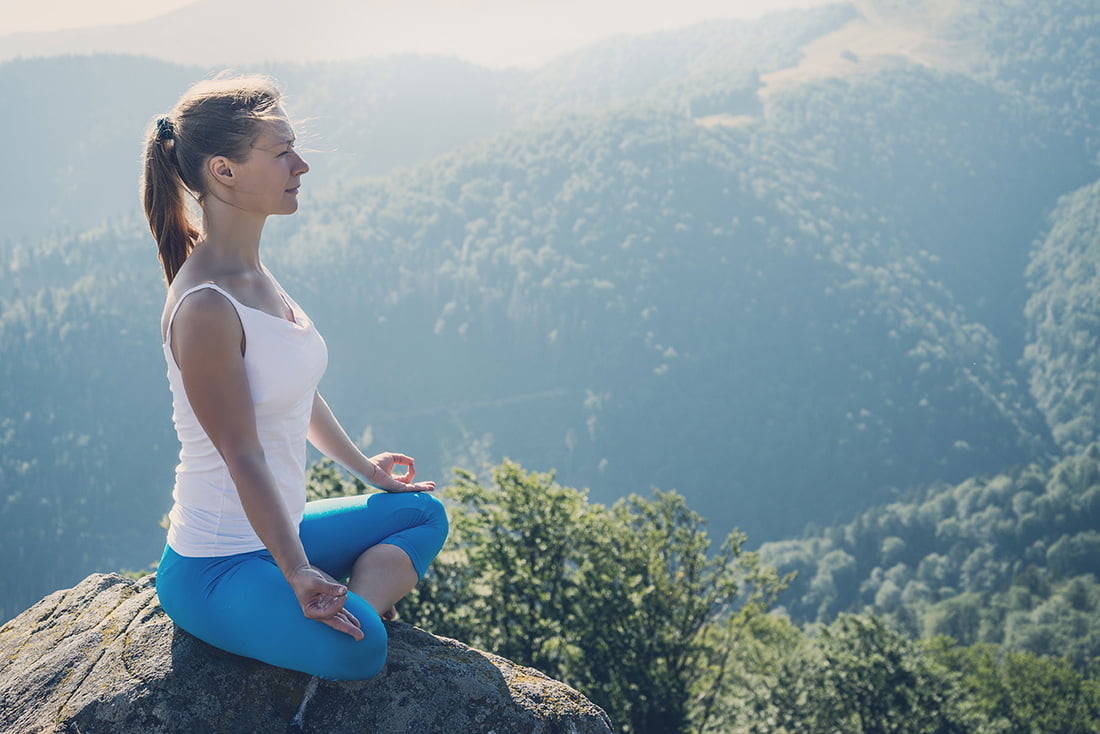
So what’s the meaning of life?
That’s for you to discover (go on, get out there and find out!).
Leave me a comment below about what you’ve discovered about the meaning of life for you. I’d so love to hear about your take on this oh-so-important question.
With love,

7 Comments
Submit a Comment
WANT MORE LIKE THIS IN YOUR INBOX?

Mental Health and COVID-19
With much of the world going into lock down as a result of COVID-19, one of the biggest global health risks we’re facing right now is mental illness. Loneliness, as a result of social distancing, and stress as a result of the financial implications of lock down and health fears, are very...

Ahiṁsā (non-violence)
Let's dive into the Yoga Sūtras together. Patañjali’s Yoga Sūtras are an ancient yogic text, and a practical guide to self-understanding and enlightenment (as we saw in this article). They outline eight limbs for achieving the goal of yoga, including the yamas, niyamas, āsana, prāṇāyāma,...

Eight Limbs of Yoga
It is thought that Patañjali was an ancient sage who wrote down the vedic knowledge of the time into sūtras, so they could be handed down orally from teacher to student. These sūtras comprise of a series of experiments or practices that are designed to realise the teachings of Sāṅkhya, teachings...
Beautiful Lauren! For me, it means following my joy, listening to my inner voice and surrendering over and over again to each unfolding moment and ALL that it presents me with! 🙂 xx
For me too Star 🙂
To awaken
Ahhh….. indeed 🙂
Thanks Lauren, make me to feel nature. spent life in nature.
This is the most important question I ask myself and on some days, it gives me extreme anxiety because I’m not sure if I’m always focusing on what is always meaningful (ie: material and non-important life issues get in the way) and then some days I feel so good about living a life grounded in simplicity and balance. I find that as long as I keep my mind at peace and my body healthy, I’m better able to help others around me. I know the meaning of life is so different for so many people.
Thanks for sharing your meaning Jen! Lovely to meet you here 🙂